The Great Schism of the Procurement World!
Why AI will split the procurement world in two
Soon, the procurement team will no longer be a single block, but the union of two very different engines: one driven by relationship and strategy, and the other driven by technology and data
In a grossly simplified way, the procurement world is divided into two parts:
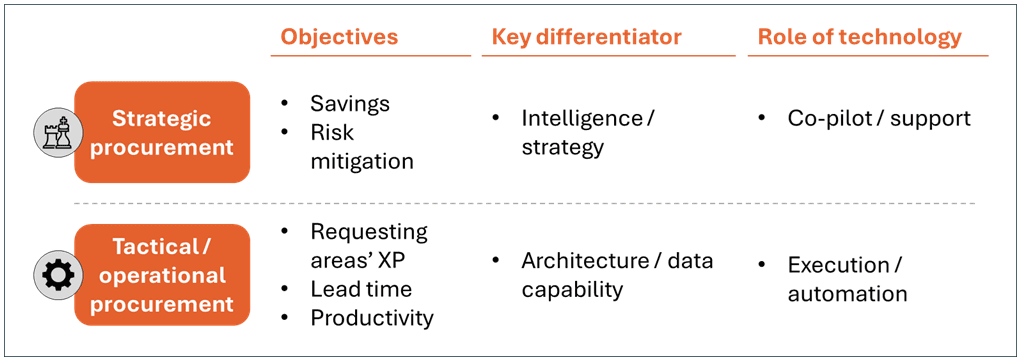
- On one side, there are strategic purchases. They are extremely complex and involve a lot of money. However, they are few in number.
- On the other side, tactic and operational purchases. They are simpler / faster. However, due to their large volume, they generate system overload. This is where the procurement team gets the reputation of "bottlenecking the company".
With IA, these worlds will drift further apart!
The strategic purchases block is extremely difficult to automate with AI, due to the difficulty of giving all the context to the AI, the political nuances between stakeholders, the complexity of predicting disruptive events in the economy, among others. In the transactional block, automation is key! (of course, not only via AI, but it will be a central component)
The strategy for each block should be obvious (but not simple to execute!):
- For the strategic block the focus should be on savings through a more traditional world: people and processes. E-proc will continue to exist in a similar way to what it is today (of course always with marginal improvements, but without executing the process itself). Intelligence / strategy here is the key (e.g.: having the vision that a commodity's price will rise or preparing for a risk of chain disruption).
- For the transactional block the focus should be on improving experience, reducing lead time and efficiency. However, here, through the creation of a sophisticated stack of well-integrated solutions: material registration tools, well-designed catalogs, buying bots, supplier registration automations, etc. In this block, the key is the technical and data capacity, to architect and connect systems / automations
The biggest mistake companies can make right now is not realizing that these two blocks exist and setting up an organization aiming only at one of them. And if I were to guess, with the AI hype, I would guess that the strategic block is the one that runs the most risk of being forgotten from an "org building" perspective.